
 English
 Español
 Deutsch
 عربى


BPA Free Electric Kettles: Materials, Certifications and Sourcing Checks
A kettle can pass a BPA free check and still hold boiling water against four plastic parts. The claim only confirms that bisphenol A was left out of the formulation. It says nothing about which polymer replaced it, how much of the water path is still plastic, or whether the material was tested at 100 degrees Celsius rather than at room temperature.
So the practical answer comes first: treat BPA free as an entry filter, not a finish line. Name the wetted materials, ask for migration test data measured at boiling point, and confirm that the certificate set matches the destination market. The sections below explain why that order of checks holds up, and how to run them during a real purchase.
Content
- 1 Why the BPA free label is weaker than it sounds
- 2 Three wetted material routes that close the question
- 3 Where plastic still sits in a BPA free kettle
- 4 Documents worth requesting before a purchase order
- 5 Matching the material to the way the kettle is used
- 6 Production, certification and shipping practicalities
Why the BPA free label is weaker than it sounds
Bisphenol A is a monomer used in polycarbonate and in some epoxy linings. Regulators have moved at different speeds, and a supplier claim usually reflects only one of them.
- The European Food Safety Authority re-evaluated BPA in 2023 and set the tolerable daily intake at 0.2 nanograms per kilogram of body weight per day, roughly twenty thousand times lower than its 2015 value (EFSA, 2023).
- The European Union adopted Regulation (EU) 2024/3190 in December 2024, restricting BPA in food contact materials, with transition periods that differ by product group.
- The US Food and Drug Administration continues to regard BPA as safe at the levels occurring in food, following its 2014 assessment, while it stopped allowing the substance in baby bottles and sippy cups in 2012 on the grounds that industry had already abandoned it.
Two consequences follow for anyone sourcing kettles. First, wording alone will not satisfy a German or French buyer who references the new EU restriction; the technical file has to show which materials are used and how they were tested. Second, removing BPA does not remove the bisphenol family. Studies published in journals such as Environmental Health Perspectives have reported that replacements like BPS and BPF can still show endocrine activity in laboratory tests, which is why retail programmes increasingly ask for a part level material declaration instead of a chemical free slogan.
Three wetted material routes that close the question
Most kettles shipped into Europe, North America and Japan fall into one of three wetted material families. Each one changes what you can claim, what a test report must cover and what the landed cost will be.
Food-grade polypropylene
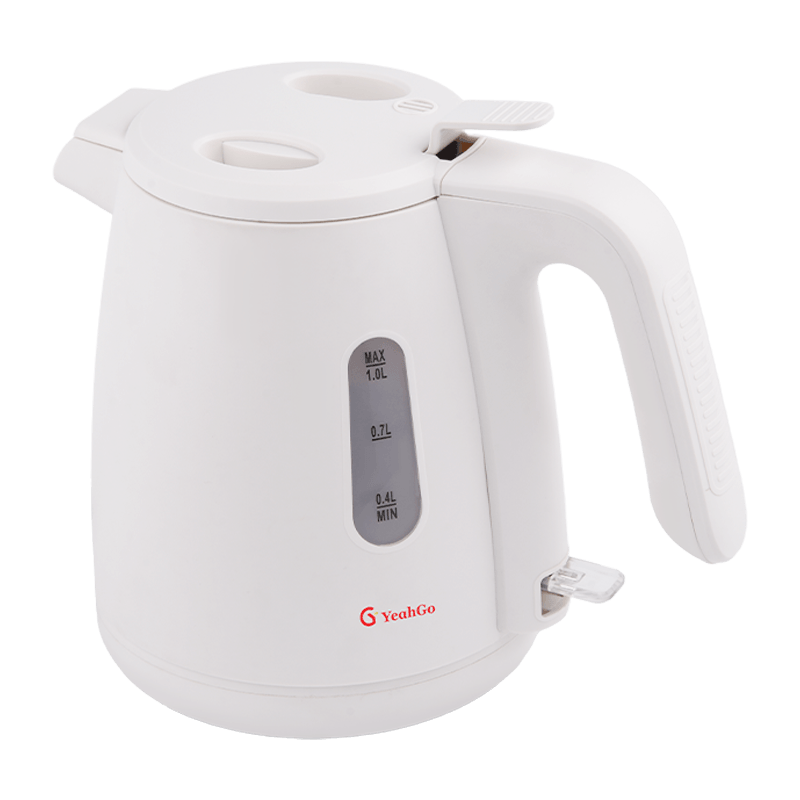
PP is BPA free by chemistry rather than by reformulation, which makes the claim stable across production batches. It softens near 160 degrees Celsius, so a 1.7 litre body stays rigid at a rolling boil, and it survives the knocks that break glass in a family kitchen. The trade-off is perception: a plastic body is still plastic in the water path. Buyers should ask for the resin grade certificate, a food contact declaration of compliance and confirmation that no recycled content enters the wetted parts.
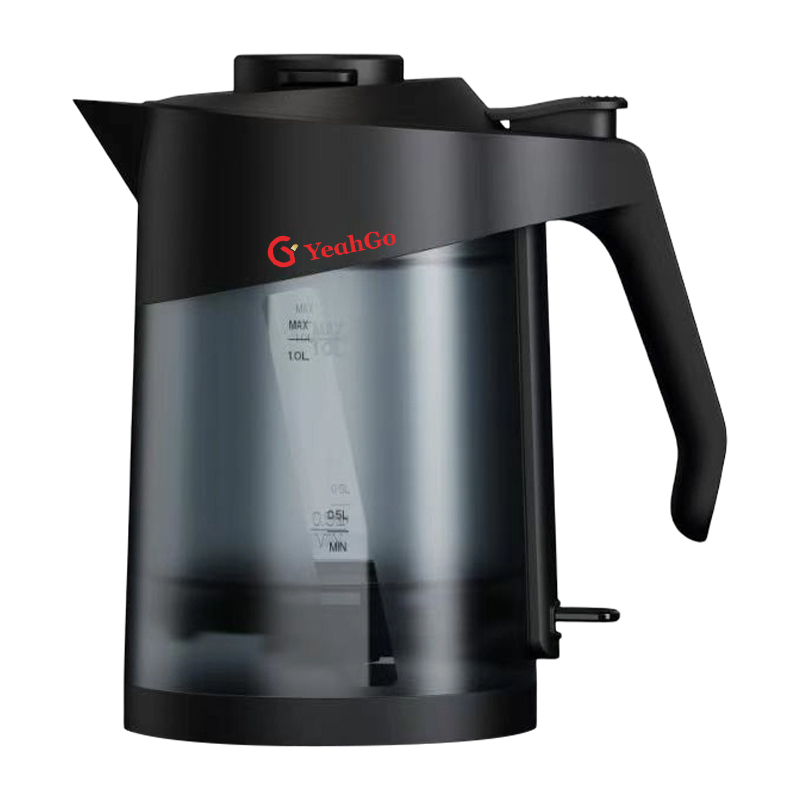
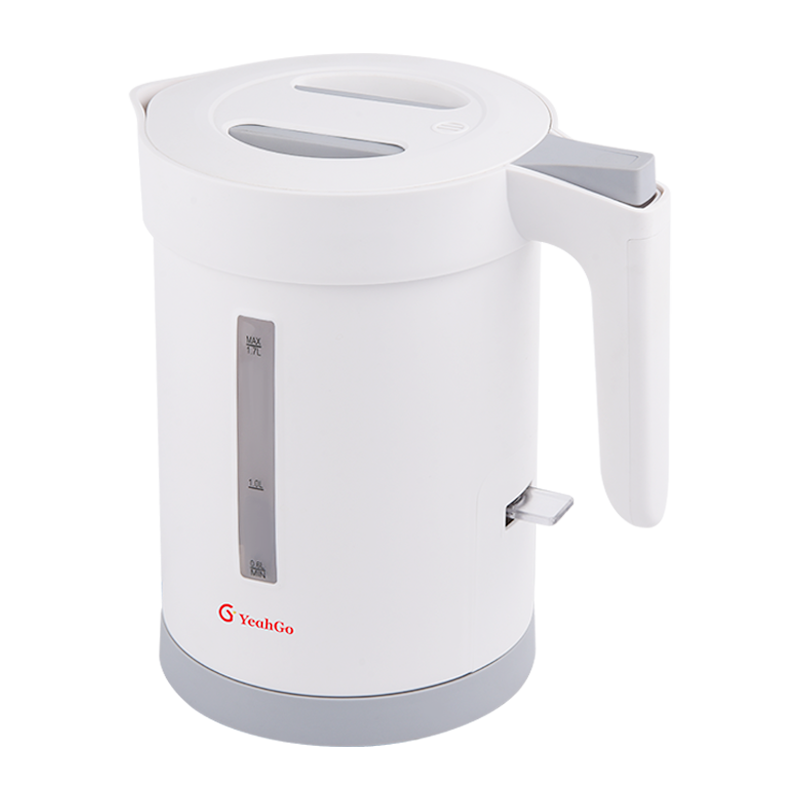 1.7L Food-Grade PP Electric Kettle with Exposed 304 Steel TubeA 1.7L matte PP kettle with visible 304 stainless heating tube, anti-splash lid and boil-dry protection; relevant when comparing plastic-bodied kettles and material documentation.View Product →
High borosilicate glass
Borosilicate 3.3, the grade defined in ISO 3585, expands very little when heated, which is why it tolerates thermal shock far better than ordinary soda lime glass. It is chemically inert and it lets the user see the water level without a plastic window. The hidden parts still matter: the base plate is usually stainless steel, and the gasket between glass and base is usually silicone, so both need their own declarations and a breakage test report that matches your packing and shipping method.
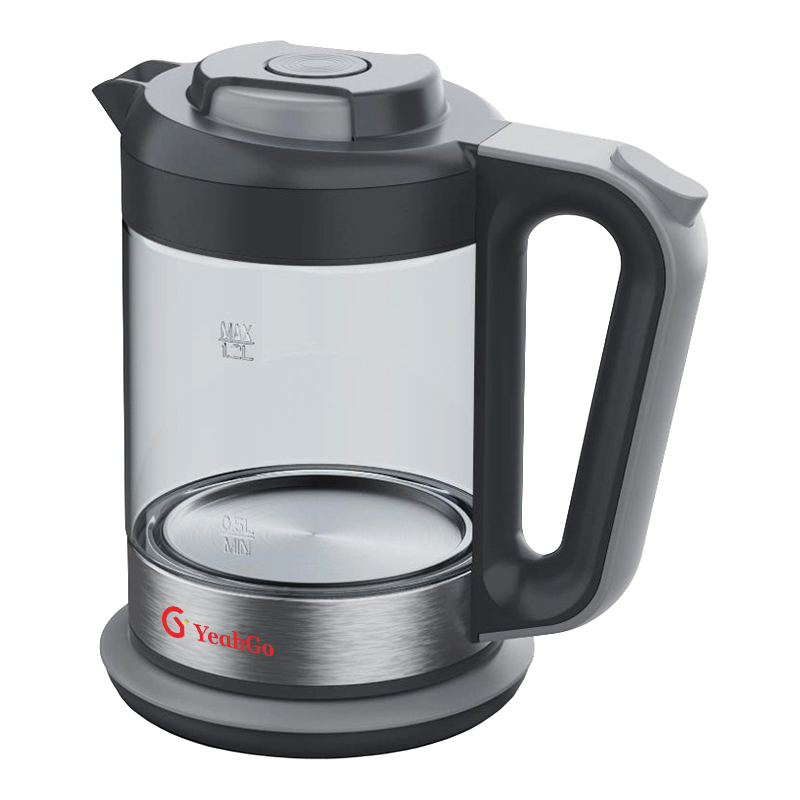
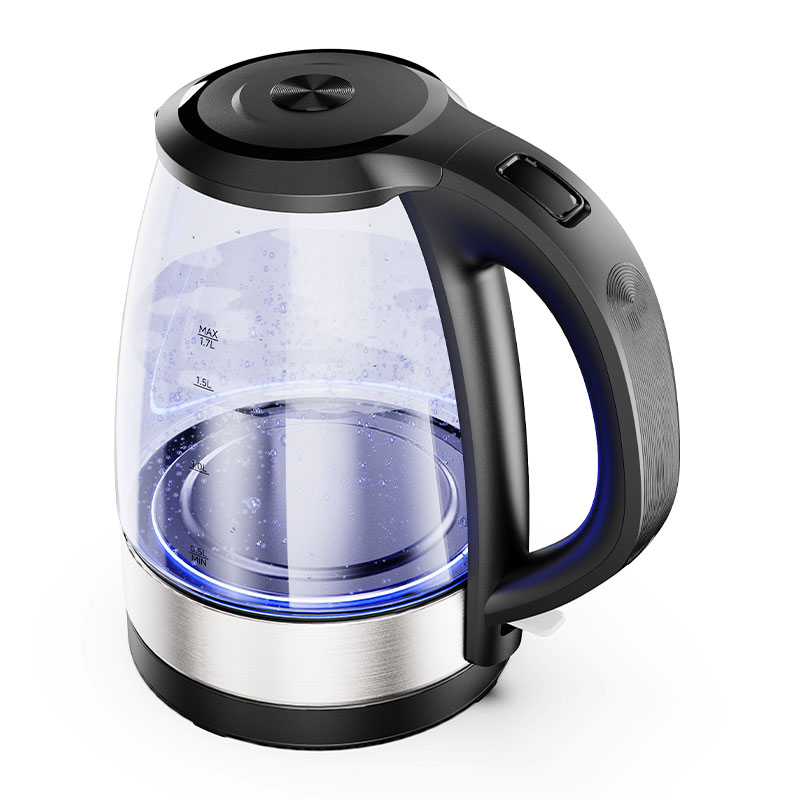 1.7L Borosilicate Glass Kettle with One-Touch Spring LidA 1.7L high-borosilicate glass kettle with 304 stainless trims and heating plate, one-press lid and 360° base; suited to visible-boiling and steel-contact comparisons.View Product →
Food-grade 304 stainless steel
Grade 304 contains roughly 18 percent chromium and 8 percent nickel, and it is unaffected by boiling water. If the lid and spout are also steel, the water path contains no polymer at all, which is the simplest story to put on a retail page. Verify the mill certificate for the steel grade, inspect the weld line inside the body, and confirm there is no plastic spout insert hidden behind the trim.
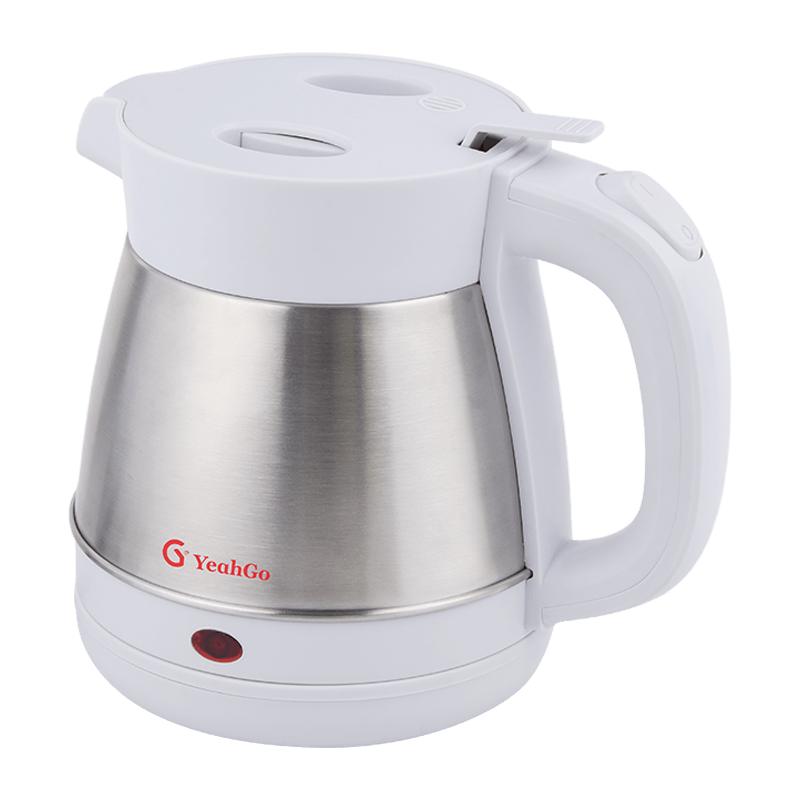
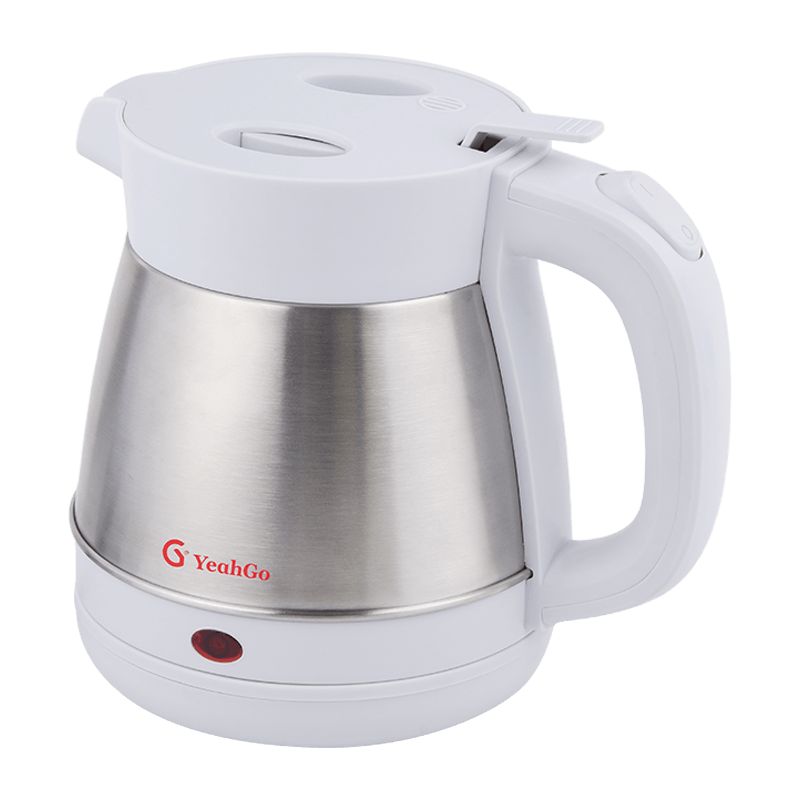 0.8L Anti-Tip Stainless Steel Compact Electric KettleA compact 0.8L kettle with seamless 304 stainless liner, weighted anti-tip base and boil-dry protection; useful where small-capacity spill resistance and steel wetted surfaces matter.View Product →
| Material | What touches the water | Heat behaviour | Best fit | Points to verify |
|---|---|---|---|---|
| Food grade PP | Body and lid, unless the lid is steel | Softens near 160 degrees Celsius, stays rigid at a rolling boil | High volume, cost sensitive, drop resistant family kettles | Resin grade certificate, food contact declaration, virgin content only |
| High borosilicate glass | Glass wall, plus a steel base plate and silicone gasket | Very low expansion, resistant to thermal shock | Tea brewing, visible boiling, gift and premium retail | Gasket and base material, drop test report, export packing standard |
| Food grade 304 stainless steel | Body, and the lid when specified in steel | Unaffected by boiling, retains heat well | Heavy daily use, hospitality, long service life | Steel grade certificate, weld quality, no plastic spout insert |
Where plastic still sits in a BPA free kettle
Even a glass or steel body usually keeps a few polymer parts, and these are the ones that decide whether the claim holds at the point of use:
- The lid assembly, including the hinge and the inner cover that faces steam.
- The spout insert on variable temperature models, which can sit directly in the pour path.
- The water level window on opaque bodies.
- The handle and its mounting collar, which conduct heat from the body.
- The silicone gasket, the cordless base connector and any internal hose on dispenser styles.
A drawing level declaration that lists each part, its polymer family and its food contact grade takes about a day to prepare and removes most of the argument later. If a supplier can only repeat the phrase BPA free without naming the parts, the file is not ready for a regulated market.
Documents worth requesting before a purchase order
The certificate list should follow the destination market rather than the factory brochure. A practical set looks like this:
- Electrical safety approval for the target region, such as GS and CE for Europe, ETL for North America, PSE for Japan, with CB reports covering the same model family.
- RoHS compliance for restricted substances in the electrical assembly.
- Food contact documentation, for example an EU 10/2011 declaration of compliance for plastic parts, LFGB test reports for the German market, FDA 21 CFR 177 references for the United States and GB 4806 reports for China.
- Overall migration and specific migration test data measured at the real service temperature, not at 40 degrees Celsius.
- Factory audit evidence such as BSCI, plus the calibration records behind the boil dry and thermal cut out tests.
Keep the test reports tied to the exact model and the exact resin grade, because a report issued for a different body material has no value in a customs or retail review.
Matching the material to the way the kettle is used
Material choice follows use. A shared office kitchen with twenty users a day rarely breaks steel, so a 304 body with a concealed element reduces replacement claims. A tea focused product benefits from borosilicate glass, because the user needs to watch the infusion and the leaf, and because glass does not hold a aroma from the previous brew. A nursery or hotel room kettle puts a premium on anti tip stability and cool touch surfaces, which favours a food grade PP body with an exposed steel band.
It helps to map demand against real behaviour rather than against a category average; these everyday uses of an electric kettle show how widely the same appliance is deployed, from boiling drinking water to warming a bottle or a glass of wine.
Production, certification and shipping practicalities
Material claims are only as reliable as the factory behind them. YeahGo, the export brand of Ningbo Yeyang Electric Appliance, has operated from Ningbo, Zhejiang since 2018 with a 6,000 square metre plant, more than 120 staff and an annual capacity above 1.2 million units. The company holds GS, CE, BSCI, ETL, RoHS, PSE and CB certification and ships mainly to Europe, North America, Japan and the Middle East. The site sits about 35 kilometres from Ningbo Beilun port, which keeps container booking and consolidation short for both full and mixed loads.
For a BPA free programme, that combination matters in three ways. Incoming resin and steel grades can be checked against the declared specification before moulding. Models can be grouped under shared CB and GS reports, which lowers the cost of adding a 1.0 litre or 1.7 litre variant. And small trial orders can run alongside larger seasonal commitments without changing the material documentation.
If you are narrowing a range, list the wetted parts and the destination market first, then let the material follow. You can send our team your specification with capacity, lid style and required certificates, and we will confirm which body materials and test reports fit the brief.
News
Products
Related Products
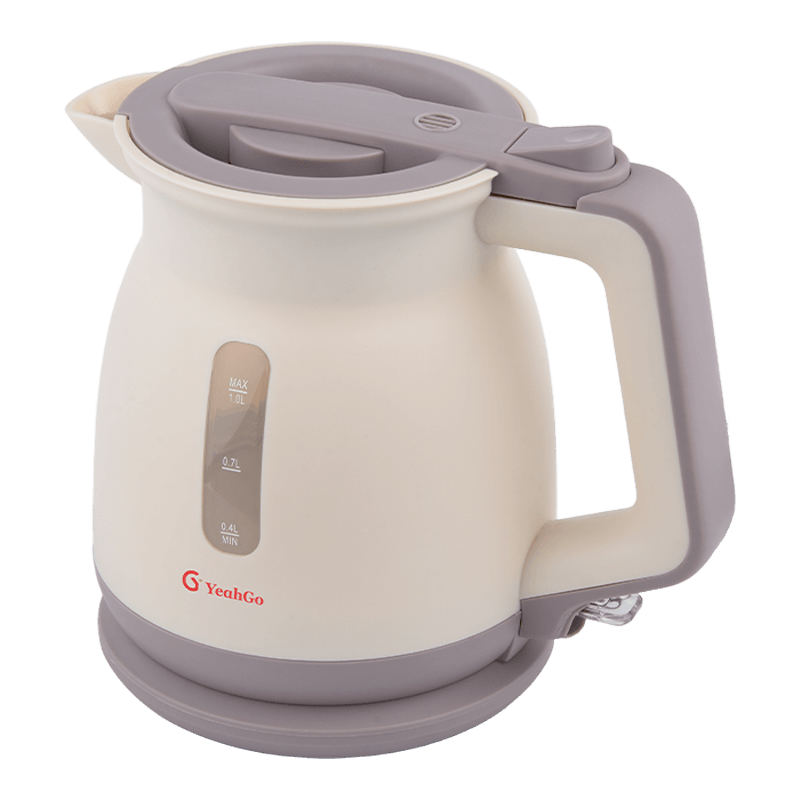
Integrated R&D, production and export full industrial chain.
Quick Link
Product
Contact Information
-
Tel:86-139 5829 1543
-
E-mail:ken@nbyeyang.net
-
Address: No. 299, Xinzhuang West District, Longquan Village, Henghe Town, Cixi City, Zhejiang Province, China
Copyright © Ningbo Yeyang Electric Appliance Co., Ltd. All Rights Reserved OEM/ODM Small Household Appliances Manufacturer Small Home Appliances Factory
