
 English
 Español
 Deutsch
 عربى


Boiling Water Kettle Buyer Guide: Boil Speed, Materials and Safety Checks
A 1.7 litre kettle filled with cool tap water should reach a rolling boil in about four to five minutes on a 2,500 W element. If the same volume takes eight minutes, the element, the base contact or a layer of scale is the problem, and no amount of design polish hides it. Boil speed, food-contact material and tip-over behaviour are what actually separate one boiling water kettle from another, so settle those three points before you look at colour, finish or price.
Content
How Fast Should a Boiling Water Kettle Be?
The energy maths is fixed. Raising one litre of water from 20 degrees Celsius to 100 degrees Celsius takes roughly 335 kilojoules, based on the specific heat of water at 4.186 joules per gram per degree Celsius, a constant listed in standard physics references. At 1,500 W and about 85 percent efficiency that works out to roughly 4.5 minutes. A 2,500 W element does the same litre in under three minutes.
Regional voltage sets the ceiling. A North American 120 V counter circuit on a 15 A breaker tops out near 1,800 W, which is why most kettles sold there carry 1,500 W elements. In 220 to 240 V markets such as the EU and the UK, 2,000 to 3,000 W is routine, and boil times are shorter for the same volume. Published test roundups match this spread: one 1.7 litre model was timed at about four minutes, while a three cup (roughly 0.7 litre) model came in at three minutes 35 seconds.
| Capacity | 250 ml cups | Element power | Expected boil time | Typical setting |
|---|---|---|---|---|
| 0.6 L | 2 to 3 | 1,500 W | 3 minutes | Single desk, hotel room |
| 1.0 L | 4 | 1,500 W | 4 to 5 minutes | Couples, small households |
| 1.0 L | 4 | 2,500 W | 3 minutes | Offices, fast-turn kitchens |
| 1.7 L | 7 | 1,500 W | 7 to 8 minutes | US retail, family kitchens |
| 1.7 L | 7 | 2,500 W | 4 to 5 minutes | EU and UK retail, tearooms |
Three physical details move those numbers further than the spec sheet suggests. Scale is the biggest: a 1 mm lime layer on a concealed element is commonly estimated to add around 10 percent to energy use, and in hard water areas the effect compounds within months. Lid fit matters too, because an unsealed lid vents heat straight out of the top. Base flatness decides how much of the element output actually reaches the water rather than the housing.
Capacity, Cup Count and the Cost of Overfilling
Cup counts are easier to work with than litres. A 1.0 litre kettle pours four 250 ml cups; a 1.7 litre model gives seven. Boiling more water than you need is the most common waste in kettle use, since every extra litre costs the same energy as the first one.
When you compare models, check the fill markings rather than the headline capacity:
- Minimum fill line, usually 0.5 litre, protects the element from running dry during a short pour.
- Maximum fill line sits below the spout; filling past it causes spitting at full boil.
- Weight when full matters in hotels and care settings, where a 1.7 litre kettle adds 1.7 kg on top of the empty weight.
- Graduated water windows make it practical to boil exactly two cups instead of a full jug.
Glass, Food-Grade PP or 304 Stainless Steel
All three bodies boil water, so the choice is about handling, visibility and where the kettle will live.
High borosilicate glass
Borosilicate tolerates thermal shock better than ordinary glass, and it lets the user see the water, which matters in tea and specialty coffee service. The trade-offs are weight and breakage risk in shared or commercial kitchens. Look for stainless steel reinforcement at the base and lid seat.
Food-grade polypropylene (PP)
PP bodies are light, cool on the outside and resistant to knocks, which is why they dominate hotel rooms and student accommodation. Confirm the grade is rated for boiling water contact and that the interior has no exposed metal edge that can trap scale.
Food-grade 304 stainless steel
Stainless heats quickly, survives rough handling and is the easiest to keep hygienic. Because the body is opaque, a water window or an external level indicator becomes important.
Compliance is worth writing into the purchase order. Food-contact claims should reference recognised frameworks such as EU Regulation 1935/2004, the US FDA food-contact rules under 21 CFR, or German LFGB testing, and the manufacturer should be able to show test reports rather than just a certificate number.
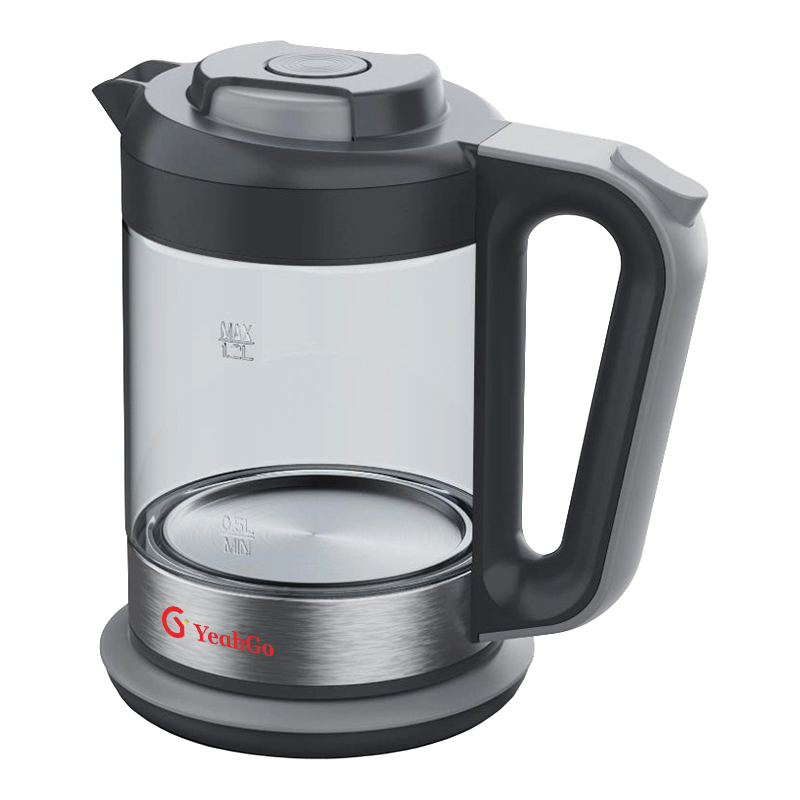
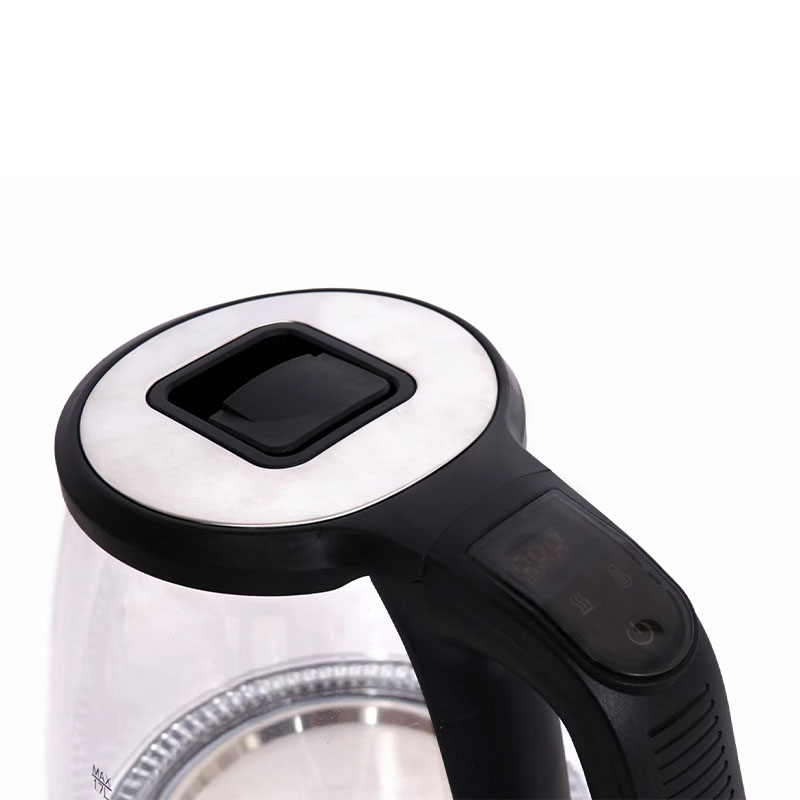 YG-305T Glass Kettle with Digital Temperature ControlView this 1.7L high-borosilicate kettle for selectable 40–100°C heating and keep-warm, plus boil-dry and overheat protection for compliance-focused buyers.View Product →
Safety Features Worth Paying For
Automatic shut-off at boil and boil-dry protection are baseline expectations in every export market; a kettle without them will not pass certification. The features that differentiate are the ones that prevent the accident before the electronics react.
- Tip-over stability. A wide base and a low centre of gravity keep a full jug upright when a sleeve catches the handle.
- Lid interlock. A latched lid prevents hot water escaping when the kettle is tipped or poured too fast.
- Cool-touch handle and body. Relevant wherever children or elderly users share the kitchen.
- Steam path. Vents should direct steam away from the handle and from sockets above the counter.
- Cordless 360 degree base. Fewer cable snags, and the jug can be lifted from any angle.
On the regulatory side, kettles sit inside the IEC 60335-2-15 family of standards, and the marks buyers ask for follow the destination market: CE and GS for Europe, ETL or UL listings for North America, PSE for Japan, with CB reports used to shorten repeat testing across markets.
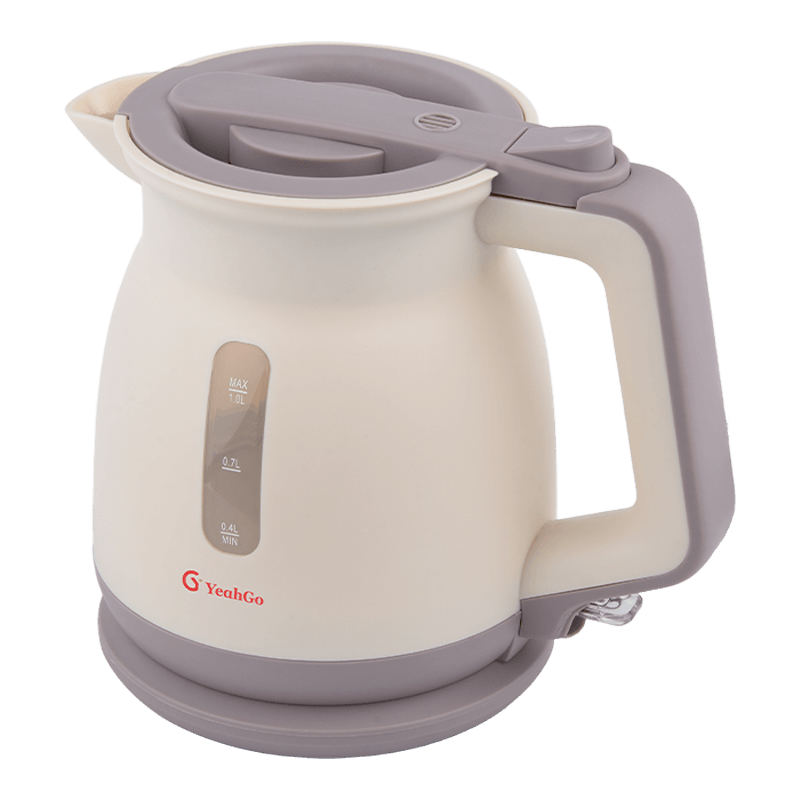
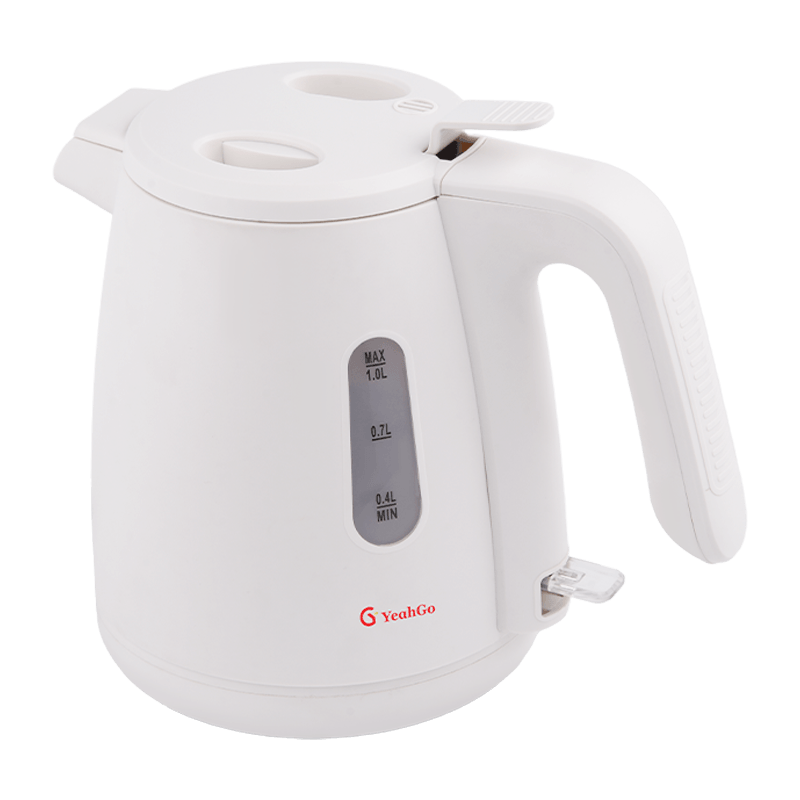
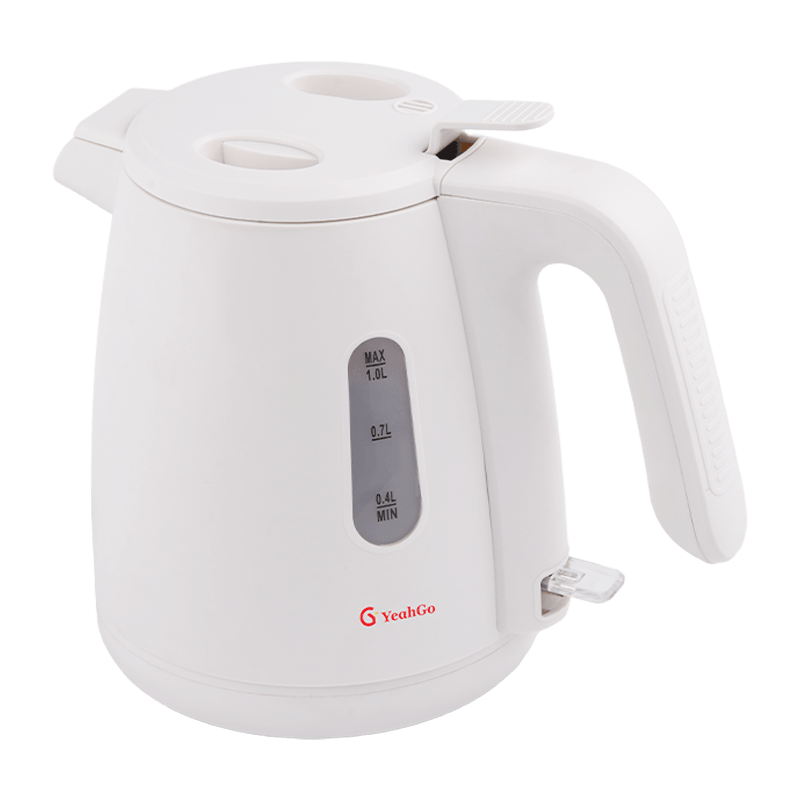 YG-618 1.0L Anti-Tip Food-Grade PP KettleReview this compact 1.0L PP kettle for its lid-based anti-tip design, visible water window, and boil-dry protection, suited to private-label programmes needing voltage variants.View Product →
Sourcing a Boiling Water Kettle at Volume
Most private-label kettle programmes run into the same three questions: can the supplier hold certification across voltage variants, can they mix a container, and can they ship on schedule.
YeahGo, the export brand of Ningbo Yeyang Electric Appliances, works in this segment from a 6,000 sq m plant with more than 120 staff and annual capacity above 1.2 million units. The factory sits about 35 km from Ningbo Beilun port, which shortens inland transport for container shipments. Certifications on file include GS, CE, ETL, PSE, CB, RoHS and BSCI, covering the European, North American and Japanese markets that most kettle buyers target.
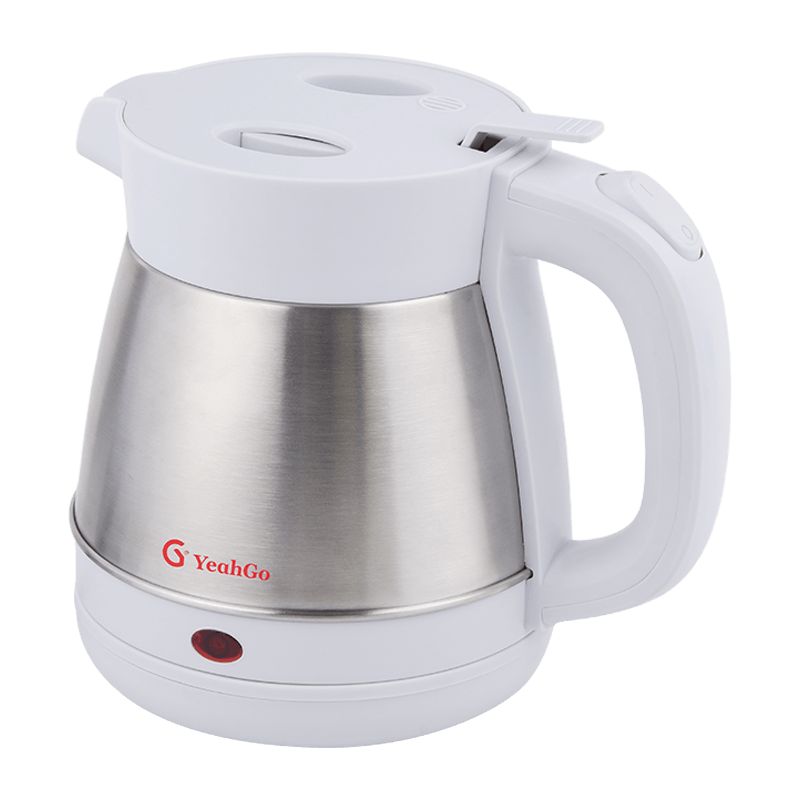 YG-619 0.8L Anti-Tipping Stainless Steel KettleConsider this compact 0.8L 304 stainless steel kettle for hotel and travel use, with anti-tip base, boil-dry protection, and detachable cord for easy storage.View Product →
For a first order, ask for pre-production samples in the exact voltage and plug configuration of the destination market, plus a packaging drop test. If you are still mapping out where kettles sit in a product line, this overview of the uses of an electric kettle is a useful starting point, and the broader electric kettle range shows how body material, capacity and lid mechanism combine into sellable variants.
A Practical Buying Checklist
- Set capacity by cup count, not shelf appeal: 1.0 litre for two people, 1.7 litre for families or shared kitchens.
- Match the element to the local circuit: 1,500 W for 120 V markets, 2,000 to 3,000 W where 230 V is standard.
- Choose body material by environment: glass for visible brewing, PP for hotel and student use, 304 stainless for heavy duty.
- Confirm automatic shut-off, boil-dry protection and a latched lid in writing.
- Request food-contact test reports and the certification set for each destination market.
- Check the descaling routine; in hard water, a kettle that cannot be opened and cleaned will fail early.
A boiling water kettle is a simple appliance with a narrow set of failure points: a slow element, a body material that cannot take the heat cycle, or a base that tips. Get those right and the rest of the decision, from finish to packaging, is ordinary product planning. Get them wrong and no feature list will keep the returns down.
News
Products
Related Products
Integrated R&D, production and export full industrial chain.
Quick Link
Product
Contact Information
-
Tel:86-139 5829 1543
-
E-mail:ken@nbyeyang.net
-
Address: No. 299, Xinzhuang West District, Longquan Village, Henghe Town, Cixi City, Zhejiang Province, China
Copyright © Ningbo Yeyang Electric Appliance Co., Ltd. All Rights Reserved OEM/ODM Small Household Appliances Manufacturer Small Home Appliances Factory
