
 English
 Español
 Deutsch
 عربى


Automatic Tea Kettle Buying Guide: Auto Shut-Off, Keep Warm and Safety
A breakfast supervisor fills a 1.7 L kettle at 6:40 in the morning, flips the switch, and gets pulled into the dining room. Forty minutes later the kettle is still warm, the element has cycled on and off half a dozen times, and nobody has poured a cup. That scene is why people search for an automatic tea kettle. It is not that they cannot press a switch. It is that they want the kettle to keep making decisions after the switch is pressed.
Short answer first. On a tea kettle, automatic is a bundle of four separate systems: shut-off protection, boil-dry protection, temperature control, and keep-warm or preset memory. A kettle can carry any one of them without the others, and plenty do. Buyers who assume the word automatic covers all four usually end up with a kettle that boils well and holds nothing.
Content
- 1 What Automatic Controls on a Tea Kettle
- 2 Shut-Off Protection Is the One Feature That Should Never Be Optional
- 3 Keep Warm and Preset Temperatures: Where Tea Actually Lives
- 4 Materials, Capacity and the Pour
- 5 How Volume Buyers Qualify an Automatic Tea Kettle Supplier
- 6 Four Specification Mistakes That Show Up After Delivery
What Automatic Controls on a Tea Kettle
Marketing copy tends to merge four or five different systems under one word. Separating them by mechanism shows which features cost real money, which cost almost nothing, and which one a buyer only notices after something goes wrong.
| Function | Mechanism | Who notices it |
|---|---|---|
| Auto shut-off | Steam sensor or thermostat cuts power at boiling point | Anyone who walks away mid-boil |
| Boil-dry protection | Second thermostat or thermal fuse trips when the element runs without water | Offices, hotel rooms, staff canteens |
| Variable temperature | Dial or presets set a target between roughly 60 and 100 degrees Celsius | Green and white tea drinkers, pour-over brewers |
| Keep warm | Element cycles to hold a set temperature for a fixed window | Breakfast service, meeting rooms, tea houses |
| Anti-tip cut-off | Lift or tilt switch isolates power when the body leaves the base or leans | Homes with children, crowded counters |
| Scheduled start | Timer plus relay switches the kettle on at a set time | A small niche; few models at ordinary price levels |
The list is not equal in weight. In most export markets a cordless kettle has to pass IEC 60335-2-15, which requires two independent means of protection when the element runs without water. That is the floor, not a feature. Everything above the floor, from a 60 degree hold to a timed start, is a design choice the buyer pays for.
Shut-Off Protection Is the One Feature That Should Never Be Optional
A steam sensor mounted in the handle trips first, when vapour reaches it. A bimetallic strip in the base acts as a second line of defence if the first fails or if someone switches the kettle on empty. Two mechanisms, two different failure modes, one job. When a supplier cannot describe both, the specification is incomplete.
Tolerance is where price differences hide. A thermostat that trips within one or two degrees of the set point on cycle one can drift over several hundred cycles, which is why volume buyers ask for endurance data rather than a single lab pass. A practical acceptance test runs 100 dry-boil cycles and 1,000 normal boil cycles, then checks that the element still cuts out within the specified window.
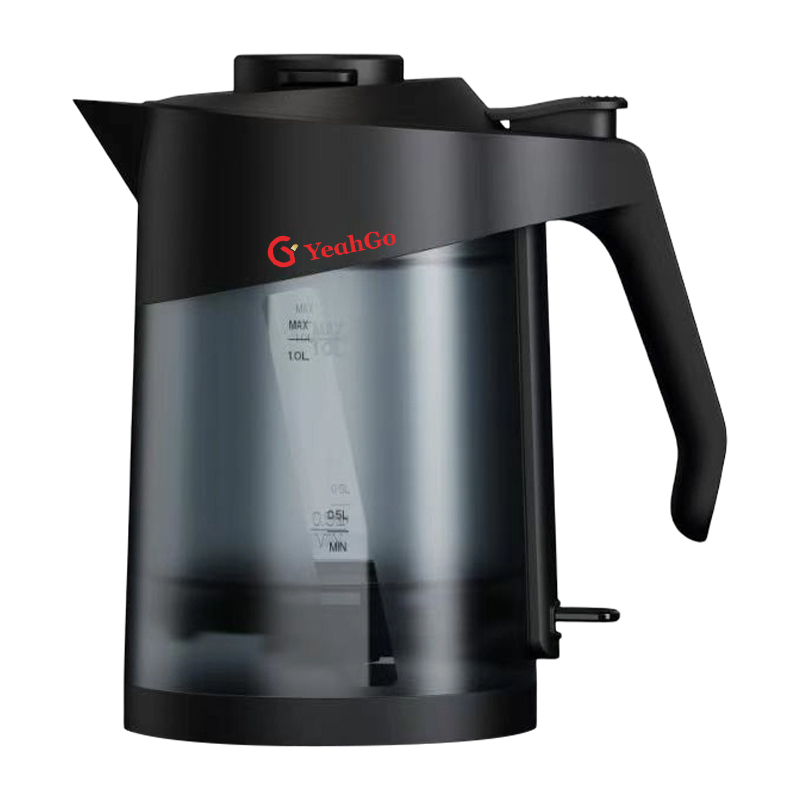
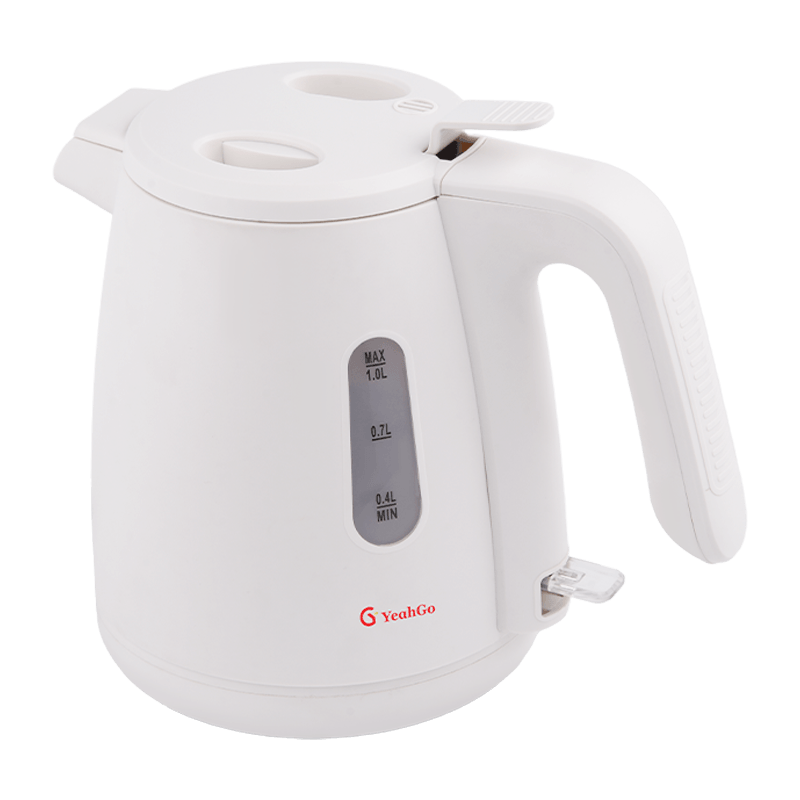
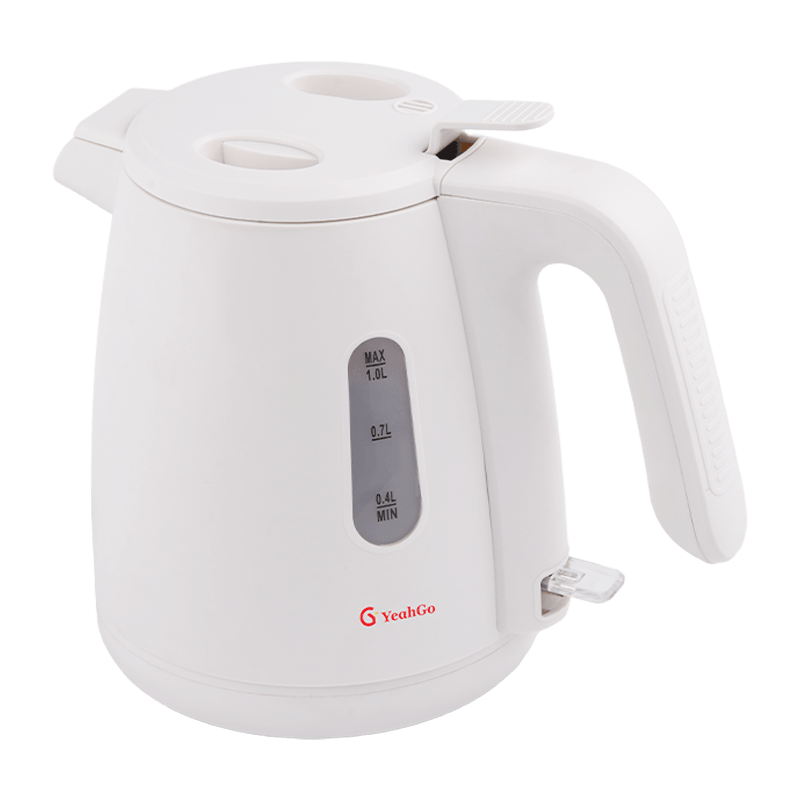 YeahGo YG-618 1.0L Anti-Tip Food-Grade PP Electric KettleA compact 1.0 L mini boiler with lid-based anti-tip protection and 304 stainless steel heating plate for safer counter, hotel, or office use.View Product →
Anti-tip design sits in the same family of questions. A switch that isolates power when the body is lifted or tipped matters on a crowded counter, in a hotel room, or anywhere a child can reach the cord. For foodservice and hospitality orders, the safest specification combines dual shut-off, a low centre of gravity, and a handle that stays cool through repeated boils.
Keep Warm and Preset Temperatures: Where Tea Actually Lives
Water temperature changes what a leaf gives up. Published brewing guidance places green and white tea around 70 to 85 degrees Celsius, oolong around 85 to 90, and black or pu-erh at or just below boiling. ISO 3103, the standardised brewing method used for sensory comparison, works from freshly boiled water, which is correct for tasting panels and wrong for a delicate first flush.
A preset kettle turns that range into two or three buttons. Staff at a tea counter stop guessing, and a 1.7 L household kettle stops scalding green tea that wanted 80 degrees. Keep warm then handles the gap between pouring and re-pouring, holding the set point instead of letting the water fall to room temperature and forcing a fresh boil.
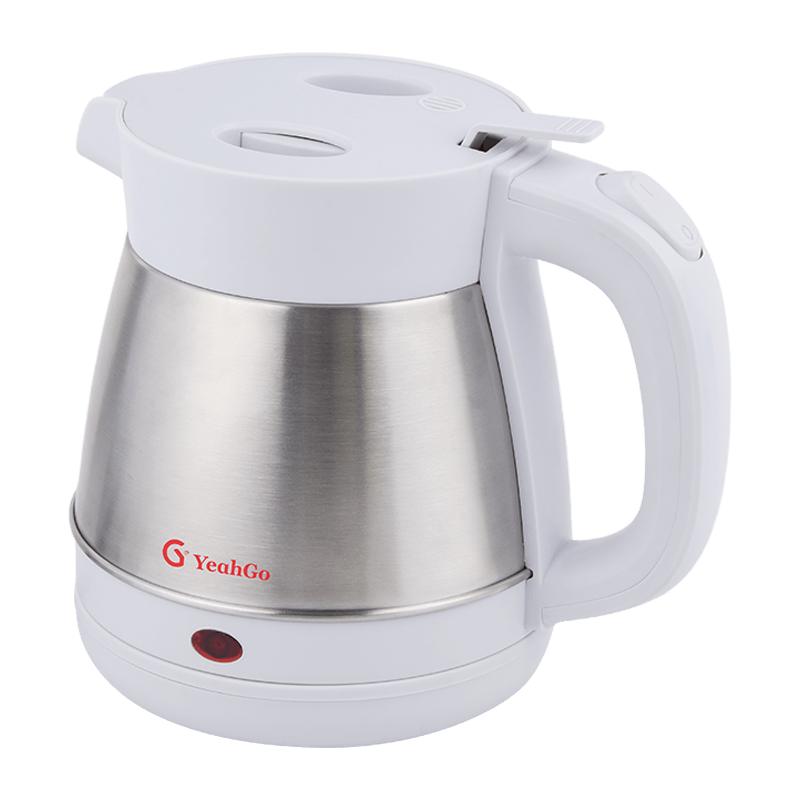
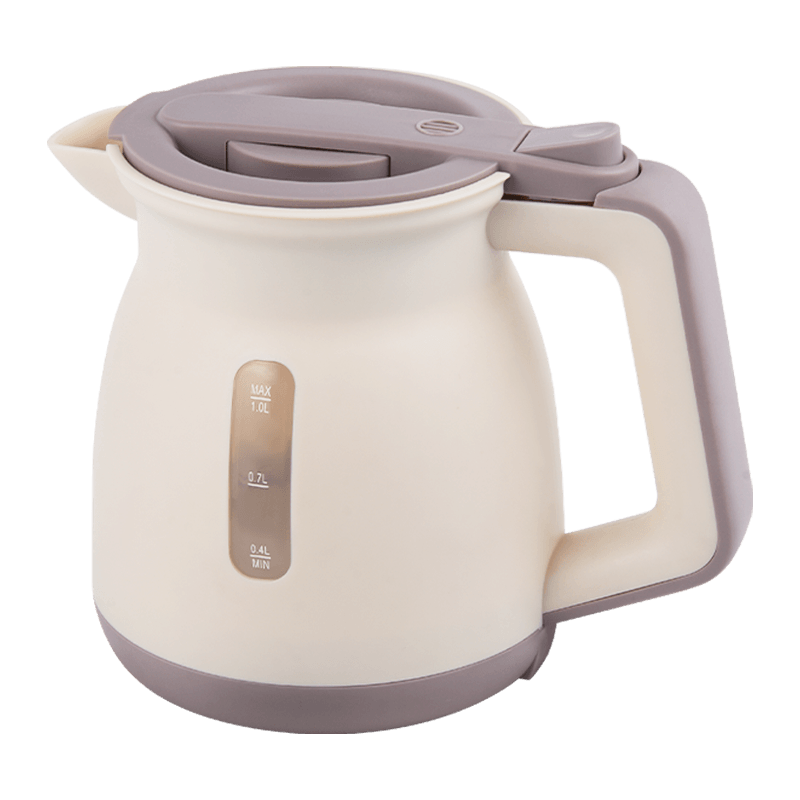 YG-668T 0.8L Anti-Tip Kettle with Constant Temperature BaseA compact 0.8 L anti-tip kettle with digital constant-temperature base and 304 stainless steel heating plate, useful where staff need preset warming and safer pouring.View Product →
Energy behaviour follows the same logic. Holding a full kettle at 85 degrees for an hour draws less power than bringing the same volume back to the boil three times, which is the pattern in most conference rooms and buffet lines. The feature pays for itself in settings where the kettle stays on all morning.
Materials, Capacity and the Pour
Anything that touches drinking water has to meet food-contact rules, such as EU Regulation 1935/2004 in Europe and FDA requirements in the United States. That narrows the realistic material list to three families.
- Borosilicate glass: no taste carryover, visible boil, and a body that suits tea service and open kitchens.
- Food-grade polypropylene: light, low cost, and a natural fit for anti-tip bodies where a low centre of gravity helps.
- Food-grade 304 stainless steel: durable, easy to clean, and often used exposed or as a partial wrap on glass and plastic kettles.
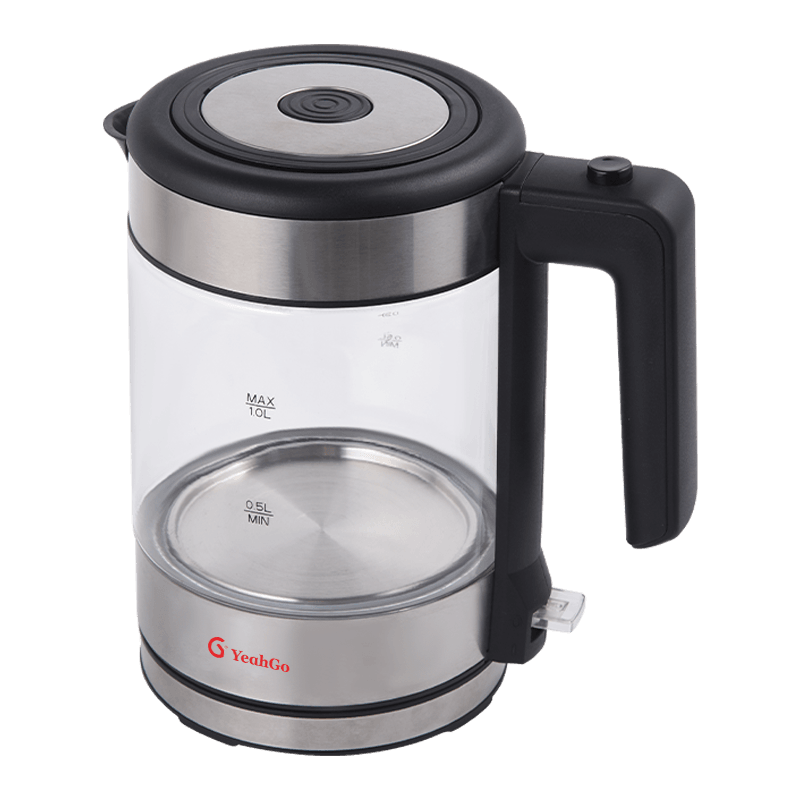
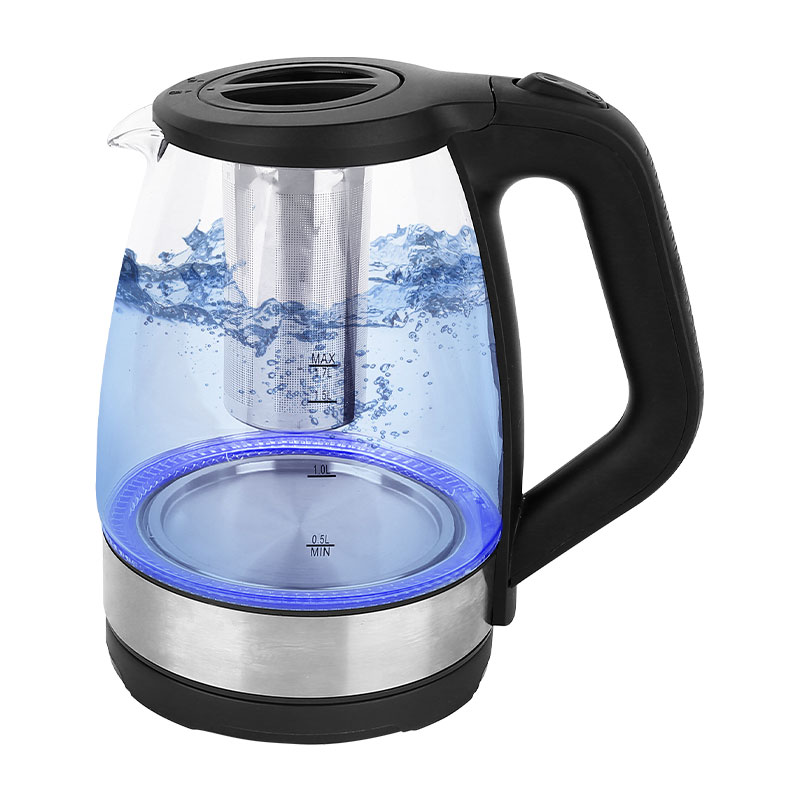 YG-305C 1.7L Glass Kettle with Detachable Tea StrainerA 1.7 L high-borosilicate glass kettle with detachable 304 stainless steel tea strainer, combining boiling and tea brewing for home, office, or hospitality service.View Product →
Capacity follows the pour, not the shelf. A 1.0 L body covers two or three cups and refills faster, while a 1.7 L body serves a family or a small office without a second boil. Larger formats exist for buffet and beverage stations where the kettle is refilled continuously. Spout shape matters just as much: a narrow spout gives control for loose-leaf tea, a wider one fills a mug quickly. A temperature display adds a second confirmation layer for staff who cannot watch the kettle.
How Volume Buyers Qualify an Automatic Tea Kettle Supplier
Certification is the first filter. For European, North American, Japanese and Middle Eastern markets, the documents that come up again and again are GS, CE, ETL, PSE, CB, RoHS and BSCI. A supplier that already holds them removes months from a launch schedule. Ningbo Yeyang Electric Appliance, which trades as YeahGo, is one example: a 6,000 square metre plant, more than 120 staff, 8 years of export experience, annual capacity above 1.2 million units, and a location 35 km from Ningbo Beilun Port for container loading.
- Request the full protection test report, not just the certificate number.
- Ask for the thermostat tolerance at cycle 1, cycle 100 and cycle 1,000.
- Confirm which material grade contacts the water and which standard it meets.
- Check keep-warm duration and whether the hold resets after a power cut.
- Ask how a mixed order of small and large quantities is scheduled.
Factory audits answer the remaining questions about process control, incoming material checks and final inspection sampling. Buyers who want to discuss a specification directly can contact the team with target capacity, market and certification list before sampling starts.
Four Specification Mistakes That Show Up After Delivery
- Treating auto shut-off and boil-dry protection as the same feature, then discovering a single thermostat on the incoming inspection bench.
- Ordering 1.7 L bodies for a counter that only ever pours single cups, which slows the boil and wastes energy.
- Specifying a preset range without checking the actual hold tolerance, so a green tea setting delivers 88 degrees instead of 80.
- Ignoring cable length and base footprint, which decides whether the kettle survives a narrow buffet counter.
Most of these are visible on the sample bench in under an hour. For a wider view of what households and small kitchens do with a kettle beyond boiling water, this overview of the different uses of an electric kettle is a useful starting point.
An automatic tea kettle earns its name in the minutes after the switch is pressed. Dual shut-off keeps the room safe, a preset range keeps the tea drinkable, and keep warm keeps the water useful without a second boil. Those three functions decide whether a kettle is genuinely automatic or simply electric.
For anyone specifying in volume, the sequence is straightforward: fix the capacity and material, define the temperature range and hold window, confirm the dual protection test data, and match the certification list to the destination market. Get those four right and the word automatic stops being a claim and starts being a measurable specification.
News
Products
Related Products
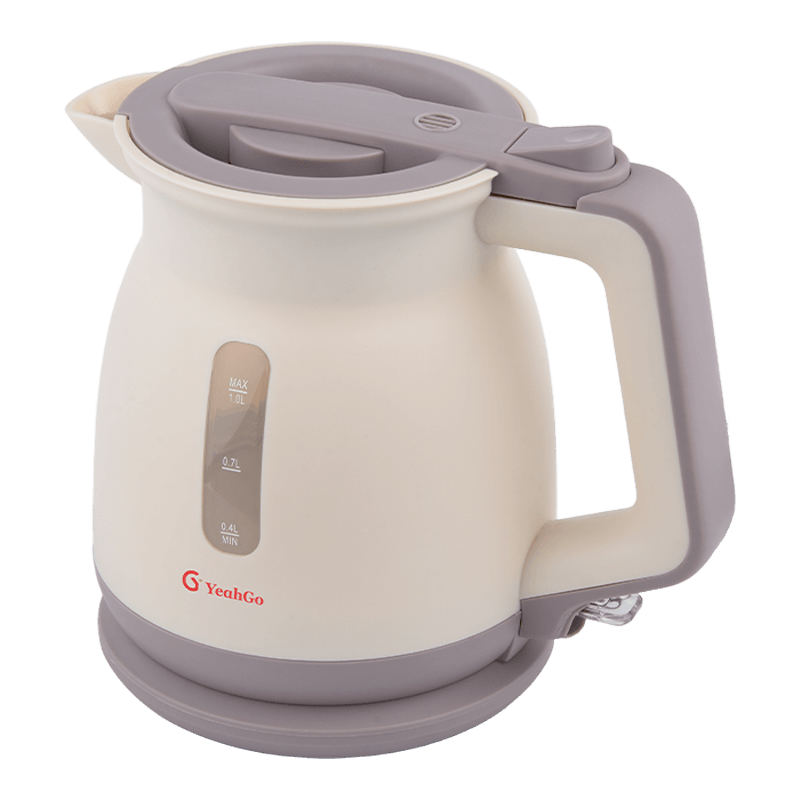
Integrated R&D, production and export full industrial chain.
Quick Link
Product
Contact Information
-
Tel:86-139 5829 1543
-
E-mail:ken@nbyeyang.net
-
Address: No. 299, Xinzhuang West District, Longquan Village, Henghe Town, Cixi City, Zhejiang Province, China
Copyright © Ningbo Yeyang Electric Appliance Co., Ltd. All Rights Reserved OEM/ODM Small Household Appliances Manufacturer Small Home Appliances Factory
