
 English
 Español
 Deutsch
 عربى


1.7L Electric Kettle Sourcing Guide: Capacity, Materials, Safety Checks
A 1.7L electric kettle is the capacity most household buyers, hotel specifiers and private label programmes settle on when they need one kettle that serves a family, an office kitchen or a breakfast buffet. A single full fill pours roughly six mugs, and 1.7 litres is still about the largest size most people can lift and pour one handed without strain. The practical order of decisions is simple: choose the 1.7L class first, then settle the body material, the lid mechanism and the temperature control around it.
Content
- 1 What One 1.7 Litre Fill Actually Covers
- 2 Specifications to Confirm Before Comparing Prices
- 3 Body Material: What Glass, PP and 304 Stainless Steel Change
- 4 Lid, Handle and Spout Details That Decide Returns
- 5 Temperature Control, Anti Tip Design and Safety Behaviour
- 6 Certification to Line Up by Market
- 7 Sourcing a 1.7L Kettle and What to Ask the Factory
- 8 A Short Procurement Checklist
What One 1.7 Litre Fill Actually Covers
Capacity claims vary between suppliers, so work from the numbers instead of the label. A 1.7 litre fill is 1,700 millilitres of water. At a 250 millilitre mug that is 6.8 mugs, and at a 350 millilitre travel mug it is 4.8 mugs. Most 1.7L kettles also carry a minimum fill line near 0.5 litres, which keeps the element submerged and lets the dry boil cut out work properly during small boils.
Boil time is set by power and voltage rather than by capacity. Raising 1.7 litres from 20 degrees Celsius to boiling absorbs about 568 kilojoules, calculated from the specific heat capacity of water at 4.18 kilojoules per kilogram per kelvin. A 3,000 W element running at roughly 85 percent efficiency delivers that in about four minutes. A 1,500 W element needs about seven to eight minutes, which is why a 120 V model can feel slow without being faulty.
Energy per full boil lands near 0.16 kilowatt hours. At 0.30 per kilowatt hour, a boil costs under five cents, so keep warm and standby behaviour, not the boil itself, is where the annual running cost is decided.
Specifications to Confirm Before Comparing Prices
Two kettles carrying the same 1.7L label can differ by 400 grams, 30 millimetres of base diameter and several minutes of boil time. Confirm the items below against the specification sheet and the test report, not against the marketing image.
| Item | Typical figure at 1.7L | Why it changes the purchase |
|---|---|---|
| Rated capacity | 1.7 L maximum, minimum fill near 0.5 L | Sets mugs per boil and the dry boil margin |
| Body material | Food grade PP, high borosilicate glass or 304 stainless steel | Drives weight, unit cost, cleaning and shelf appeal |
| Rated power | 1,500 W at 120 V, 2,200 to 3,000 W at 220 to 240 V | Sets boil time and the limits of the plug and circuit |
| Lid mechanism | One touch pop up, spring loaded or manual pull | Decides one hand use and part of the return rate |
| Base | 360 degree cordless, 0.7 to 1.0 m cord | Affects docking and counter placement |
| Controller | Auto switch off at boiling plus dry boil cut out | Core compliance item and field failure risk |
| Standby consumption | 0.5 W or lower in off or standby mode | Relevant to EU ecodesign limits and retailer scorecards |
| Empty net weight | 0.9 to 1.4 kg | Determines pouring comfort at full capacity |
Body Material: What Glass, PP and 304 Stainless Steel Change
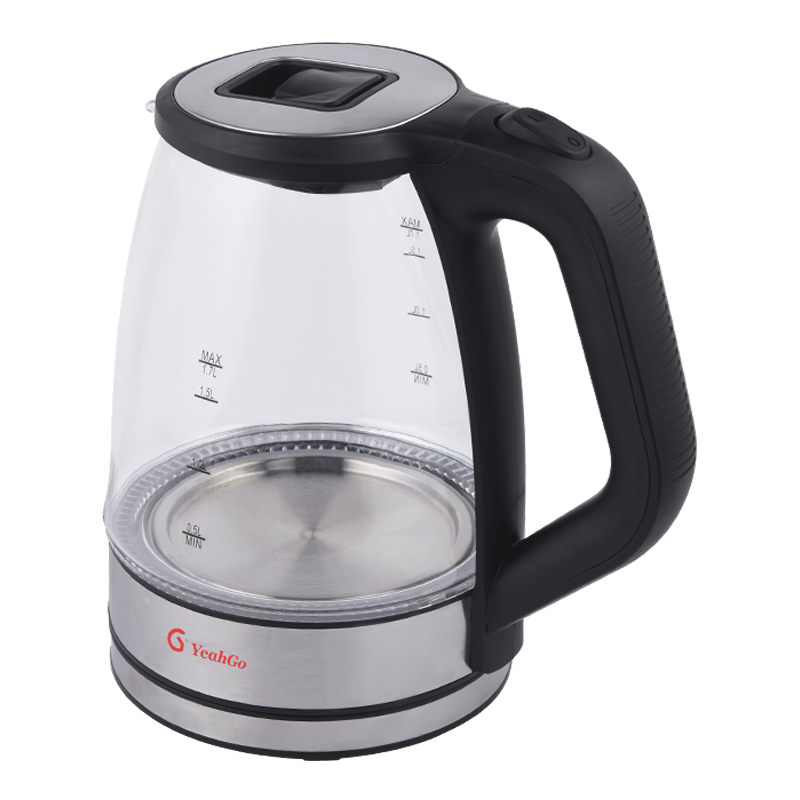
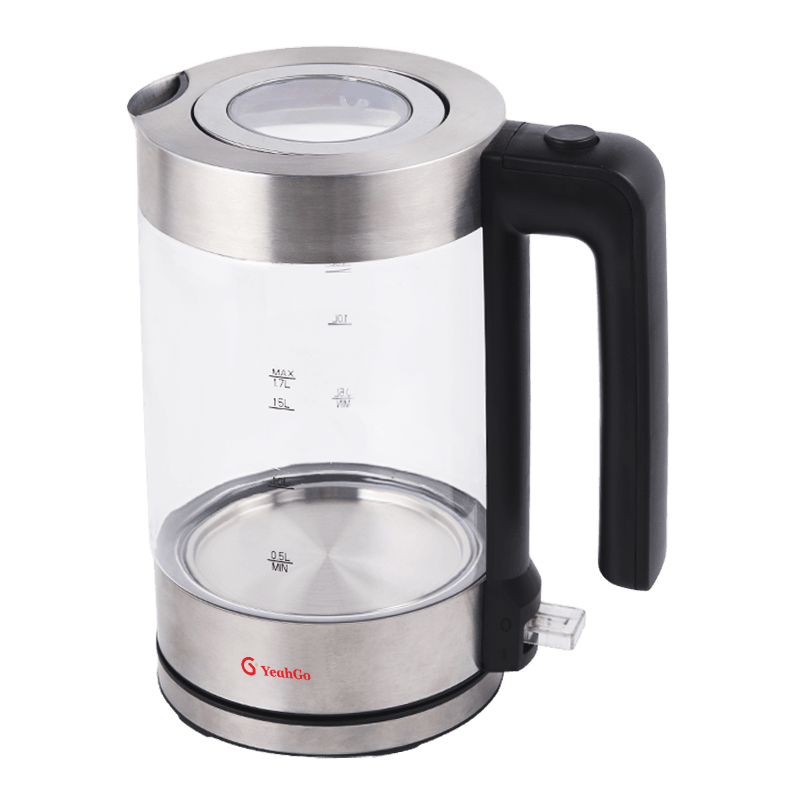
High borosilicate glass shows both the water line and the boil, and it tolerates the thermal shock of rinsing a hot body. The trade off is cost and weight: a glass 1.7L body typically adds 300 to 400 grams over an equivalent PP shell, and that difference is felt on every pour at full capacity. A 1.7L high borosilicate body with a stainless trimmed base is a common way to pair visibility with a metal look, and the glass kettle range covers cylindrical, pear shaped and double wrapped builds.
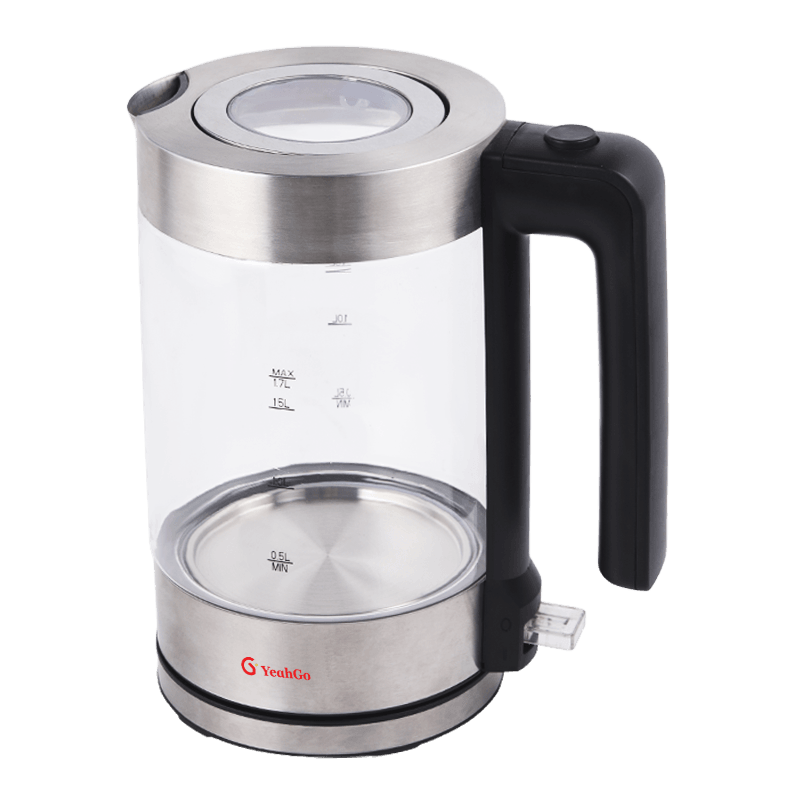 1.7L High Borosilicate Glass Kettle with Stainless TrimA transparent 1.7L glass option with stainless rings and one-touch flip lid, suited when visible water level and metal trim matter.View Product →
Food grade PP is the lightest and lowest cost option at 1.7 litres, which is why it dominates volume programmes. Confirm food contact compliance in writing: FDA 21 CFR Part 177 in the United States and EU Regulation 10/2011 in Europe. PP also hides limescale, so if the destination market cares about visible cleanliness, specify a water level window or a glass panel rather than a fully opaque wall.
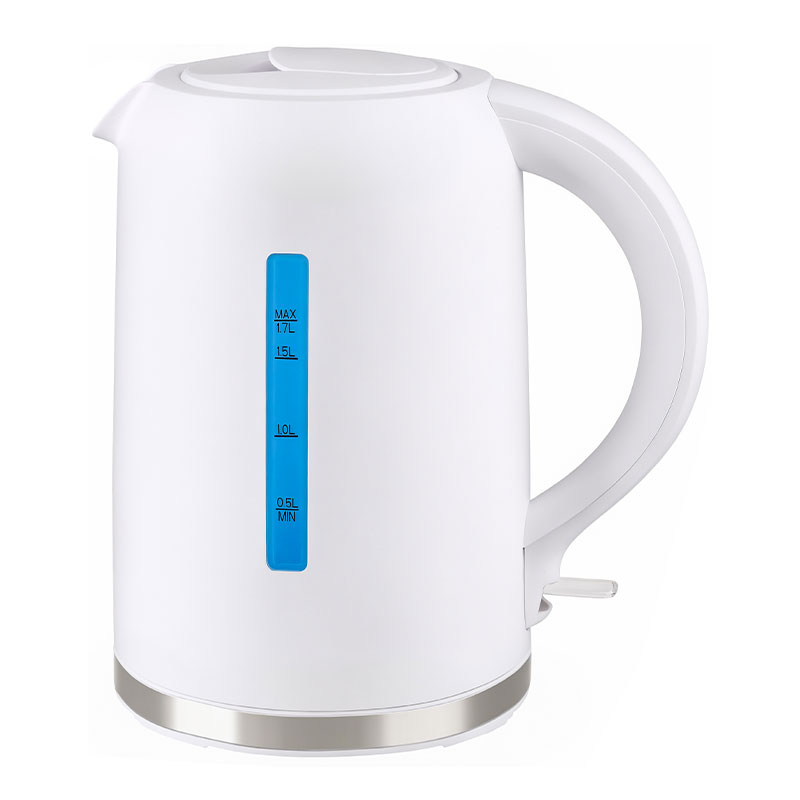 1.7L Food-Grade PP Kettle with Water Level WindowA lightweight 1.7L PP-bodied kettle with visible water window and 304 stainless heating plate, matching low-cost volume needs.View Product →
Food grade 304 stainless steel belongs on every surface that touches water, regardless of the outer shell. A fully stainless body resists impact well, but a bare steel wall reaches uncomfortable temperatures, so many 1.7L designs wrap only the lower body in steel and keep a cool touch PP or glass upper section. That mixed construction is also easier to certify for surface temperature.
Lid, Handle and Spout Details That Decide Returns
Lid design generates more consumer complaints on 1.7 litre kettles than any electrical fault, because a full body holds a large volume of steam at boiling point. Check these points on a sample before tooling:
- One touch pop up lid: opens with a thumb press and stays open while filling, best for one hand use.
- Manual pull lid: fewer moving parts and lower cost, but it usually needs two hands at 1.7 litres.
- Spring loaded lid: sits flat when closed, useful where the kettle lives under a wall cabinet.
- Mouth diameter of 80 to 100 mm: allows hand access for descaling and wiping.
- Removable spout filter: catches limescale before it reaches the mug.
- Handle to spout geometry: the pour stream should clear the handle at maximum fill, not just at half fill.
Temperature Control, Anti Tip Design and Safety Behaviour
Anti tip geometry matters more at 1.7 litres than at 1.0 litres, because the water mass is heavy enough to shift the centre of gravity when the body is bumped. A wider base, a lower centre of gravity and a lid that stays shut when the body is knocked sideways all reduce scald risk in a kitchen with children or in a hotel buffet where the kettle sits at counter height. A food grade PP body with an exposed stainless lower section is a practical way to combine a cooler exterior with a stable footprint.
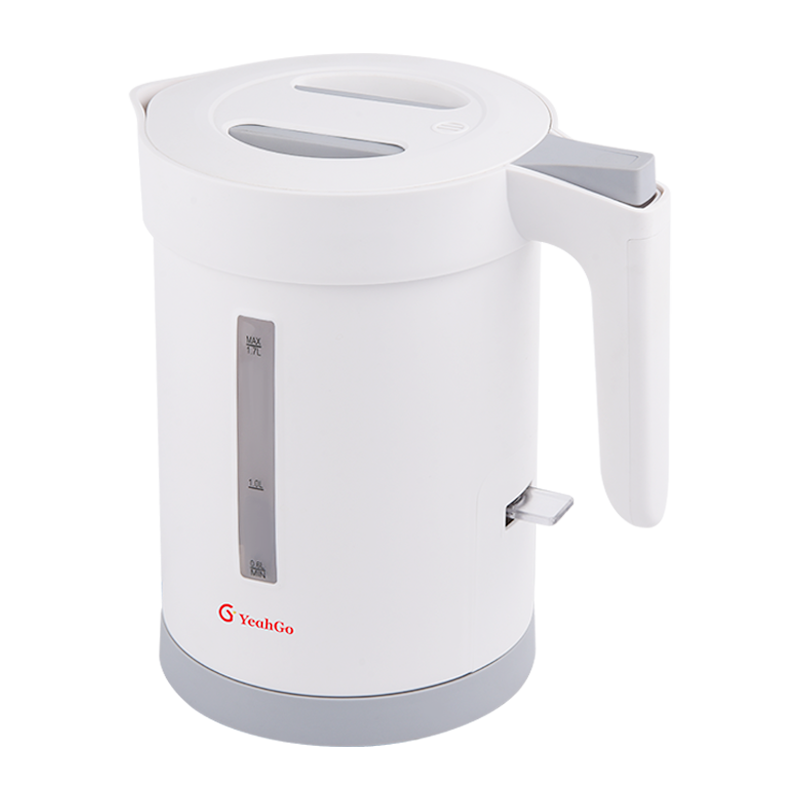 1.7L Anti-Tip Food-Grade PP Kettle with Exposed Heating TubeA stable 1.7L PP kettle with exposed 304 stainless heating tube and anti-splash lid, useful where tip resistance and simple temperature control are priorities.View Product →
Temperature selection adds a second control layer: variable set points, a keep warm function and a display. For tea and pour over coffee, the useful range is 60 to 100 degrees Celsius in 5 degree steps, with a hold tolerance of plus or minus 2 to 3 degrees. Confirm that tolerance on the test report, because a display reading 80 while the water sits at 74 will still generate complaints, even if the kettle itself is working.
The core safety reference for kettles is IEC 60335-2-15, read together with IEC 60335-1. It covers automatic switch off at boiling, dry boil protection, stability and lid behaviour, and it is the document a buyer should quote when the supplier claims compliance.
Certification to Line Up by Market
Compliance is market specific, and the marks a factory already holds in volume tell you how much new testing a private label programme will need.
| Market | Marks to hold | Practical note |
|---|---|---|
| European Union | CE under LVD 2014/35/EU, EMC 2014/30/EU and RoHS 2011/65/EU, GS voluntary | Retailers frequently request GS on kettles |
| United States and Canada | ETL or UL listing, state labelling rules such as California Proposition 65 | Cord set and plug must suit 120 V, 15 A circuits |
| Japan | PSE mark with METI notification | Plug shape and 100 V rating differ from Europe |
| Middle East | G mark or SASO depending on the country | Voltage 220 to 240 V, plug type varies by state |
| Multiple markets | CB scheme report based on IEC 60335-2-15 | Speeds up national approvals and avoids repeat testing |
Sourcing a 1.7L Kettle and What to Ask the Factory
For a 1.7 litre programme, the factory profile matters as much as the sample. YeahGo, based in Ningbo, Zhejiang, operates a 6,000 square metre plant with more than 120 staff and annual capacity above 1.2 million units, with exports running at roughly 1.2 million units per year across Europe, North America, Japan and the Middle East. The site sits 35 km from Ningbo Beilun port, which keeps container loading and export documentation predictable for programmes shipping to multiple regions.
Certifications already held include GS, CE, BSCI, ETL, RoHS, PSE and CB, which shortens the compliance path for most destinations. Delivery flexibility is worth confirming early as well: a supplier that can hold a large volume order steady while still responding to smaller trial quantities is easier to scale with than one that only quotes full container loads.
Feature scope deserves the same early attention, because a 1.7 litre kettle is often bought for more than tea and coffee, from instant noodles to quick household tasks. Reviewing the common uses of an electric kettle before tooling is committed helps you decide whether to pay for a keep warm function, a wider mouth or a simpler fixed temperature design.
A Short Procurement Checklist
- Fix the destination market and voltage first: 220 to 240 V for Europe and the Middle East, 120 V for North America, 100 V for Japan.
- Match the element rating to the plug and circuit: 2,200 to 3,000 W on 220 to 240 V, 1,500 W on 120 V.
- Obtain food contact certificates for every part that touches water, referencing FDA 21 CFR Part 177 or EU Regulation 10/2011.
- Ask for dry boil and auto switch off data from the CB or GS report, not a written assurance.
- Weigh the empty kettle against the full 1.7 litre load, since anything above 1.4 kg empty becomes a comfort issue for older users.
- Review carton drop test results, because a glass 1.7L body travels badly in thin packaging.
- Set the off mode and standby power limit in the purchase specification if the buyer sells into the European Union.
- Agree the lid life cycle target, typically several thousand open and close cycles, and ask for the test record.
A 1.7L electric kettle is a simple product with a short list of decisions that actually change the outcome: real capacity and weight, material of every water contact surface, lid behaviour at full fill, stability, and the certification that matches the market. Get those five right and the rest of the specification, from finish to packaging, becomes a matter of margin rather than risk.
News
Products
Related Products
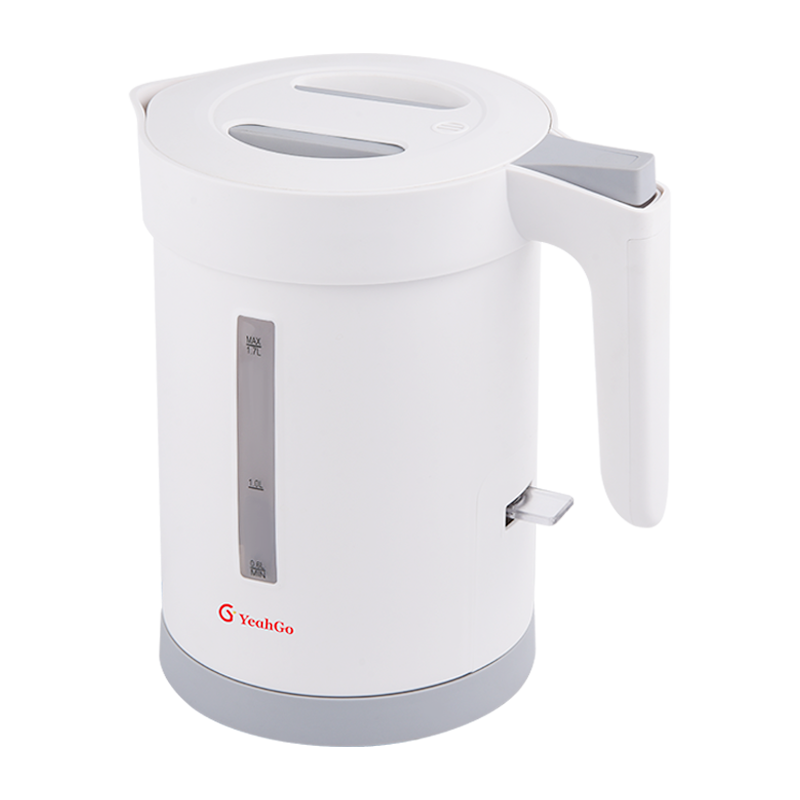
Integrated R&D, production and export full industrial chain.
Quick Link
Product
Contact Information
-
Tel:86-139 5829 1543
-
E-mail:ken@nbyeyang.net
-
Address: No. 299, Xinzhuang West District, Longquan Village, Henghe Town, Cixi City, Zhejiang Province, China
Copyright © Ningbo Yeyang Electric Appliance Co., Ltd. All Rights Reserved OEM/ODM Small Household Appliances Manufacturer Small Home Appliances Factory
