
 English
 Español
 Deutsch
 عربى


All Stainless Steel Electric Kettle: Steel Grades, Safety and Sourcing Guide
A 1.7 L stainless kettle came back from a German retailer last spring with brown speckles along the spout weld. The coil certificate said 304, the invoice said food grade, and the unit still failed a 48 hour salt spray check. Nothing in the material claim was technically false.
That case explains the conclusion this article starts with: the phrase all stainless steel electric kettle tells a buyer almost nothing on its own. What decides whether a kettle lasts five years or five months is the grade of every water contact part, the condition of the weld after passivation, and how many non steel parts hide in the lid, window and base. Check those three items and returns drop. Check only the word stainless and they rarely do.
Content
What an All Stainless Steel Kettle Really Covers
On a retail label, all stainless steel usually means the shell and the water contact surface are metal. In a factory bill of materials, the same kettle splits into six or more parts, and the steel claim rarely covers all of them:
- Body shell: 304 or 201 stainless, drawn in one piece or welded from two halves.
- Base plate and heating disc: 304 or 430 stainless, sometimes with a diffuser plate underneath.
- Lid, hinge and handle: PP, ABS, or steel with a silicone gasket.
- Water level window: glass or polycarbonate, sealed with food grade silicone.
The shell and the base plate cause most corrosion complaints, because that is where water sits longest and where scale collects.
| Grade | Typical composition | Chloride and corrosion behaviour | Typical position in a kettle | Relative coil cost |
|---|---|---|---|---|
| 304 (18-8) | 18 to 20 percent chromium, 8 to 10.5 percent nickel | Good in most tap water, pitting risk above roughly 200 mg per litre chloride | Body shell, base plate, water contact parts | Baseline |
| 316 | 16 to 18 percent chromium, 10 to 14 percent nickel, 2 to 3 percent molybdenum | Best chloride resistance of the three | High end bodies for coastal and Middle East markets | 1.3 to 1.6 times 304 |
| 201 | 16 to 18 percent chromium, 1 to 4 percent nickel, 3.5 to 5.5 percent manganese | Moderate, should not sit in water long term | Trim rings, handles, outer covers | 0.7 to 0.85 times 304 |
| 430 | 16 to 18 percent chromium, no nickel, magnetic | Lower, surface rust is possible | Some base plates and outer shells | Lowest |
Grade 201 can look identical to 304 after polishing, and it will still pass the magnet test many buyers use as a shortcut. A handheld XRF reading takes about thirty seconds and settles the question per coil lot.
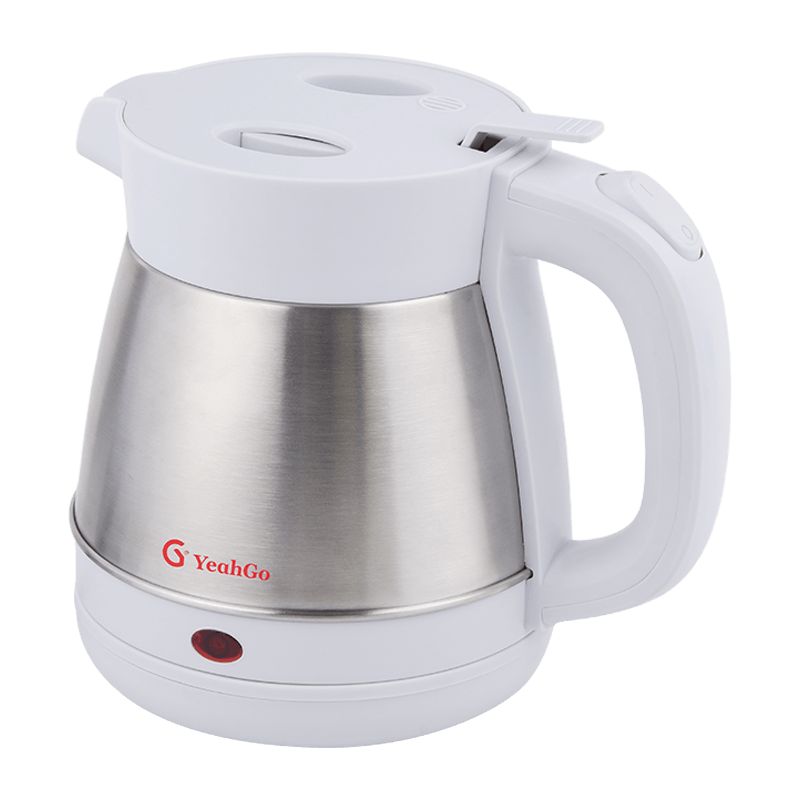 Stainless Steel Kettle Category for Home, Office, and Hotel ProgramsExplore stainless kettle types for household, office, cafe, and compact settings, including food-grade 304 options and the YG-619 anti-tipping model.View Product →
Where Stainless Kettles Actually Fail
Warranty claims trace back to three causes, in this order:
- Unpassivated weld seams. Welding burns chromium out of the surface layer and leaves a heat tint. Without pickling and passivation to ASTM A380 practice, free iron sits on the surface and red rust appears within weeks, even on genuine 304.
- Chloride pitting under scale. Limescale traps chlorides against the steel, so a kettle boiled dry twice a week and never descaled pits faster than one used daily and cleaned monthly.
- Mixed metals in one water path. A steel body with a low grade trim ring or an unsealed threaded fitting forms a galvanic couple, and the less noble metal goes first.
Electronics matter too. IEC 60335-2-15 requires boil dry protection and a thermal cut out on cordless kettles in most regulated markets, and a steel kettle with a weak thermostat generates as many returns as a rusted one.
Capacity, Form Factor and Anti Tip Design
Capacity drives both steel thickness and element power. A compact 0.8 L unit with a 1200 W element boils in about three minutes and suits hotel rooms, desks and single servings. A 1.7 L kettle typically needs 1500 to 3000 W to stay under six minutes; published lab rounds have measured close to five minutes on 1.7 L stainless models at the higher end of that range (Consumer Reports, 2026 electric kettle tests, which covered kettles from 4 to 7 cups). If you want a wider view of how end users actually employ these appliances at home and in small offices, this overview of electric kettle uses is a useful reference.
Steel also changes the shape of the product. Because the body cannot be moulded like PP, a full steel kettle usually gets a wider footprint and a heavier lid, so anti tip behaviour comes from geometry rather than an added weight. For buyers filling compact kitchenettes or hotel trays, that geometry is often the deciding factor.
YG-619 0.8L Anti-Tipping Compact Stainless Steel Electric KettleCompact 304 stainless boiler with anti-tip geometry and dry-boil protection; check electrical and food-contact approvals separately for target markets.View Product →Certification and Food Contact Approval
Electrical approval and food contact approval run on separate tracks, and both belong in the purchase agreement. On the electrical side, GS and CE cover Europe, ETL covers North America, PSE covers Japan, and a CB report shortens the work needed for the rest. RoHS restricts substances in the electronics rather than in the steel. On the food contact side, EU Regulation 1935/2004 and FDA 21 CFR 175.300 govern what may touch drinking water, and LFGB is often requested alongside GS.
Ningbo YeahGo, the manufacturer behind this site, lists GS, CE, ETL, PSE, CB, RoHS and BSCI certification and states that stainless kettles are produced in a 6,000 square metre plant with more than 120 staff and annual capacity above 1.2 million units (company data). Those figures are less useful as marketing than as a filter: an audit trail per production lot is what keeps a certificate valid after the first container ships.
What an All Steel Design Gives Up
Steel is opaque, so a full steel kettle cannot show water level without a window. Adding one puts glass or polycarbonate in the water path and weakens the all stainless claim. Two other trade offs appear in testing. Steel bodies radiate heat, so a boiled kettle cools more slowly than glass and stays hot to the touch longer unless it is double walled. Polished steel also shows fingerprints and water spots more than matte finishes.
Buyers who need visibility usually choose a hybrid: a glass body with stainless trim and a steel wrapped base, or a steel kettle with a glass window and temperature display. Both keep the visual weight of metal while accepting one non steel component.
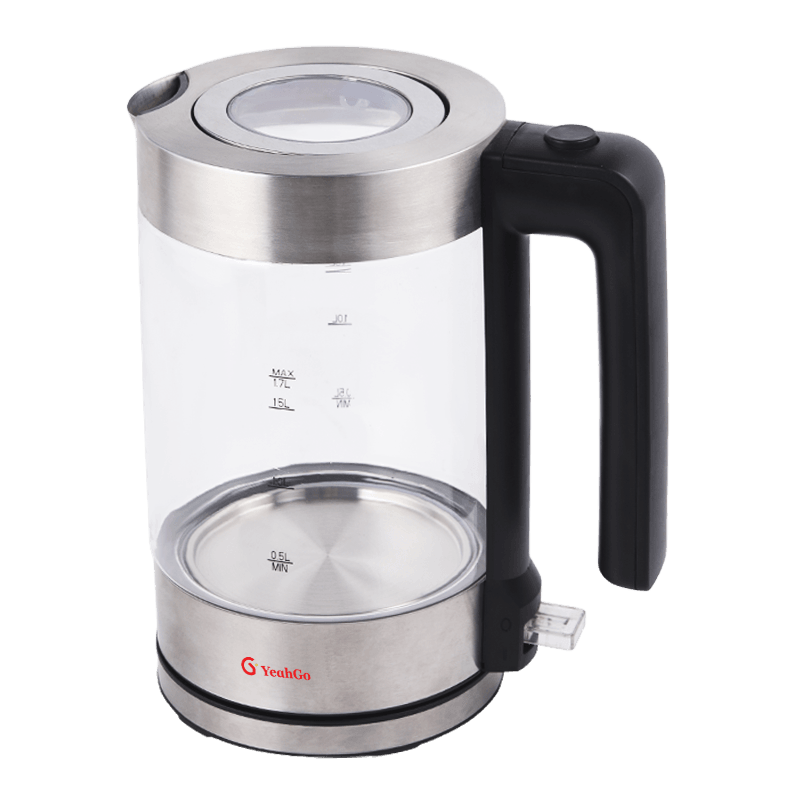 YG-320 1.7L One-Touch Flip Lid Glass Kettle with Stainless TrimTransparent high-borosilicate kettle with 304 stainless trim, one-touch flip lid, and boil-dry protection; a hybrid choice for hotels, offices, and homes.View Product →
A Practical Sourcing and QC Checklist
- Verify the grade of every coil lot with XRF and file the readings next to the mill certificate.
- Specify wall thickness, typically 0.4 to 0.6 mm for a 1.7 L body, on the drawing rather than in purchase order text.
- Request a passivation report for each welded seam, referenced to ASTM A380.
- Require 100 percent hi pot and leakage testing, plus a boil dry test on a sample from each lot.
- Print descaling guidance in the manual; it protects the warranty as much as the consumer.
- Confirm voltage and plug type per destination: 120 V for the United States, 220 to 240 V for Europe, 100 V for Japan.
- Fix a packaging drop test standard and container loading plan, because a dented steel body arrives as a return regardless of its grade.
Logistics belong in the same conversation. A plant 35 km from Ningbo Beilun port can consolidate and ship within a predictable window, which removes the temptation to cut steel grade in order to absorb freight delays (company data).
An all stainless steel electric kettle is a material claim, not a quality guarantee. Grade, weld passivation and the number of non steel parts in the water path decide the outcome, and all three can be verified before a deposit is paid. Buyers who write those checks into the specification get a kettle that still looks new after two winters of hard water. Buyers who accept the label alone get the salt spray report instead.
To discuss a specific capacity, certification market or private label programme, contact the YeahGo team and send your target specification.
News
Products
Related Products
Integrated R&D, production and export full industrial chain.
Quick Link
Product
Contact Information
-
Tel:86-139 5829 1543
-
E-mail:ken@nbyeyang.net
-
Address: No. 299, Xinzhuang West District, Longquan Village, Henghe Town, Cixi City, Zhejiang Province, China
Copyright © Ningbo Yeyang Electric Appliance Co., Ltd. All Rights Reserved OEM/ODM Small Household Appliances Manufacturer Small Home Appliances Factory
